The history of QR codes begins in 1994, when Masahiro Hara at Denso Wave — a subsidiary of Toyota — invented the format to track car parts on Japanese assembly lines. Three decades later it became the universal scan format of restaurant menus, mobile payments, and Wi-Fi onboarding. This article walks through that journey in five short chapters, explains why the QR code looks the way it does, and ends with where the format is heading next.
1994: A factory–floor problem
The QR code was invented in 1994 at Denso Wave, a Japanese subsidiary of the Toyota Group, by a small team led by an engineer named Masahiro Hara. The problem they were trying to solve was unglamorous: traditional one–dimensional barcodes (the kind on cereal boxes) could only hold about 20 characters, which was not enough to track the rich variety of car parts moving through a Toyota assembly line. Workers were having to attach as many as ten barcodes to a single component just to capture the necessary information.
Hara's team set out to design a code that could hold an order of magnitude more data while still being reliably scanned at speed by industrial readers. Two design constraints shaped the result: it had to be fast (the "Quick Response" in the name), and it had to be tolerant of the dirt, smudges, and abrasion typical of a real factory floor. The Reed–Solomon error correction that survives a coffee stain on your menu was originally meant to survive engine grease.
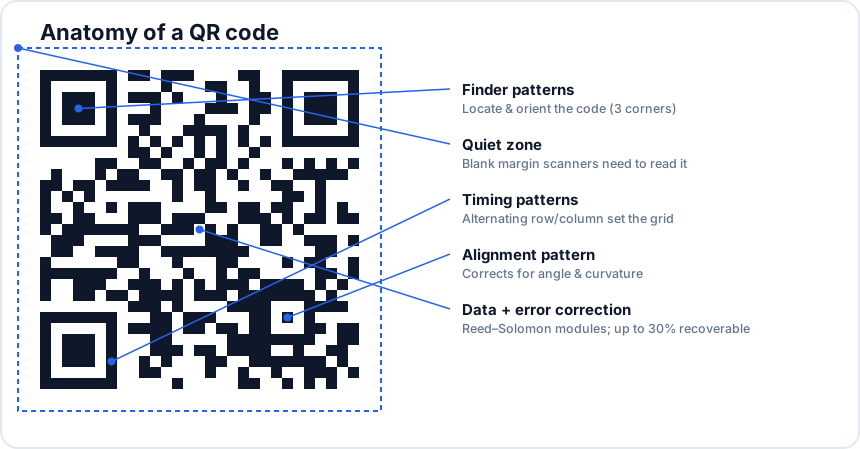
The breakthrough was the three large nested squares in the corners — the finder patterns — which let a scanner instantly locate the code regardless of orientation. Hara reportedly settled on the design after spending lunches studying which black–and–white patterns appeared least often in printed magazines, so that the finder pattern would be unmistakable even surrounded by other graphics.
The patent that quietly enabled everything
Denso Wave patented the QR code, but they made an unusual decision: they declared they would not exercise the patent rights against anyone using it. The standard was open and royalty–free. In 2000, ISO/IEC standardised the QR code format (ISO/IEC 18004), and any device manufacturer or software developer could implement it without licensing fees.
This is one of the most consequential decisions in the history of consumer technology. A patented–and–enforced format would have stayed locked inside Toyota's factories. The royalty–free standard, meanwhile, became the universal default the moment phones gained cameras good enough to scan it. Almost every other competing 2D barcode format that arrived later — Aztec, Data Matrix, MaxiCode — saw narrow industry adoption. QR became the consumer format almost by accident.
Japan first, then a long pause
QR codes spread quickly in Japan in the early 2000s. Japanese mobile carriers built QR scanners into the cameras of feature phones years before the smartphone era, and by 2003 you could find QR codes on cigarette packs, train station maps, and product packaging across Tokyo. The format was so embedded in Japanese marketing that the term "QR code" appeared on news graphics and billboard ads as casually as a phone number.
In the rest of the world, almost nothing happened. Western mobile phones did not include native QR scanning. Users had to download a dedicated app, launch it, point it at the code, and wait for it to open the URL in a browser. The friction was enough to keep adoption stuck. Through the 2010s, QR codes appeared in Western advertising in flashes — mostly as gimmicks — and then quietly disappeared. Trade press routinely declared them dead.
2017: The native–scanner moment
The shift was set in motion by two software updates. In 2017, Apple added native QR–code scanning to the iPhone Camera app in iOS 11 — no separate app, no menu, just point–and–tap. Android followed across 2017–2019, eventually adding QR detection to Google Lens and the default camera apps on most major Android phones.
Suddenly the friction was gone. Scanning a QR code became literally faster than typing a URL. The format was already standardised, royalty–free, and supported on every device; the only missing ingredient had been a frictionless scanner, and now every smartphone shipped with one.
2020: Pandemic adoption curve
The Covid–19 pandemic took the slow–simmering trend and threw petrol on it. Restaurants needed contactless menus. Health systems needed contactless check–in. Governments needed contactless contact–tracing apps. Within months, QR codes went from a curiosity to a public–health utility. Once they were on every restaurant table, returning to printed menus became a deliberate decision — one most operators did not bother to make.
By 2022, QR codes were a routine part of marketing, payments, ticketing, packaging, and even authentication flows like WhatsApp Web sign–in and 2–factor enrolment. The format was 28 years old and finally an "overnight" success.
Where QR codes are going
Three trends are visibly shaping the next stage of QR–code use. The first is payments: QR–based payment rails (PIX in Brazil, MB WAY in Portugal, Alipay and WeChat Pay in China, UPI in India) have become primary payment methods for hundreds of millions of users, leapfrogging card–based infrastructure entirely in markets where contactless cards never took hold. The QR code is now in many places the default checkout interface, not the curiosity beside it.
The second is provenance and supply chain: regulators in the EU and elsewhere are mandating QR–based digital product passports for batteries, textiles, and certain electronics, where each product unit carries a code linking to its origin, materials, and recyclability. This is QR returning to its industrial roots — tracking parts — but at consumer scale.
The third is credentials and identity: digital driving licences in several US states, EU–wide digital wallets, vaccination certificates, and event tickets are increasingly delivered as signed QR codes that can be verified offline. The same format that opens a coffee–shop menu now also signs cryptographic claims you carry through airport security.
In the background, the format is also evolving. rMQR (rectangular Micro QR), introduced in 2022, fits a smaller QR–type code into rectangular spaces (think labels on slim products). JAB Code and HCC2D add colour to two–dimensional codes for higher data density. None of them have yet displaced the original square QR code — the network effect of universal scanner support is hard to beat — but the family of post–QR formats is maturing quietly.
Why the boring format won
If you take a step back, the QR code's success is a case study in a common pattern: the technology that wins is rarely the technically most elegant one. It is usually the one that was open, good enough, and already deployed when the moment arrived. QR was patented but freely licensed. It was good enough by 1994 standards and only marginally improved since. By the time mobile phones could scan codes well, the standard was already on a billion product packages in Japan and a few hundred million elsewhere.
For people building or printing QR codes today, the practical takeaway is simple: the format is durable, freely usable, and unlikely to be displaced any time soon. The PNG or SVG you export from QRStudio in 2026 will scan correctly on whatever phone you own in 2040, for the same reason a 1994 Toyota part code still scans on factory hardware today — the standard is open, ISO–documented, and built around a problem that does not change.