In much of the world, “scan to pay” isn't a novelty — it's simply how you pay. But the friendly little square hides very different machinery depending on where you are: a bank rail in one country, a central-bank system in another, a super-app wallet in a third. This is a plain-English tour of how QR payments work, the big national systems behind them, and the one safety habit that matters no matter which one you're using. It's an overview, not financial advice.
How a QR payment actually works
There are two directions. In the common merchant-presented flow, the shop shows a code and you scan it with your banking or wallet app, which reads the payee's details and lets you confirm the amount. In the consumer-presented flow, your app shows a code and the merchant's terminal scans you. Either way, the QR code isn't money — it's just an instruction that says “pay this account,” encoded in a format the payment app understands.
Merchant codes come in two forms. A static code is a fixed sticker for one payee; you type the amount in. A dynamic code is generated per transaction at the till with the amount already baked in, so you just confirm. The static/dynamic distinction is the same idea as in ordinary QR codes — see our guide to static vs. dynamic codes — and it matters for both convenience and safety.
The big systems, by region
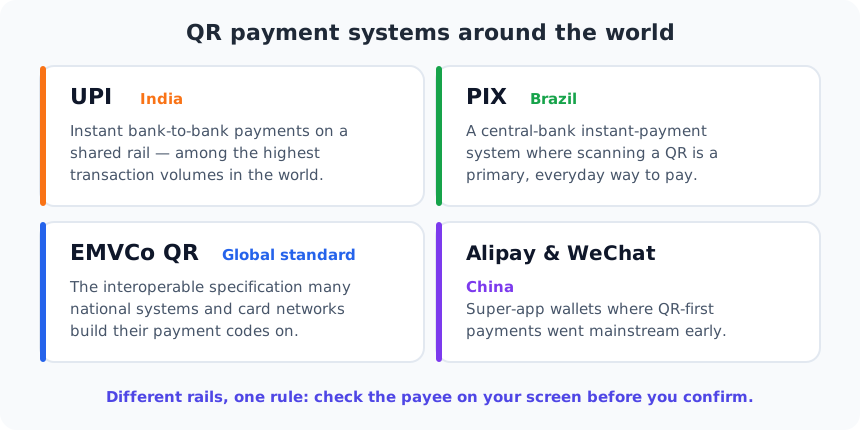
India — UPI. The Unified Payments Interface links banks on a single real-time rail, so money moves instantly between accounts at different banks. Scanning a shop's QR and paying straight from your bank app is everyday behaviour, and UPI now handles some of the highest transaction volumes of any payment system on earth.
Brazil — PIX. Run by the central bank, PIX brought instant, low-cost payments to the whole country, and its QR standard made scan-to-pay a default at everything from market stalls to big retailers — a striking example of a public-sector system reshaping how a nation pays in just a few years.
China — Alipay & WeChat Pay. Long before much of the world, China went QR-first through two dominant super-app wallets. Cash became rare in cities as buyers and sellers exchanged QR codes for everything from street food to utility bills — the model that showed everyone else what QR payments at scale could look like.
The global glue — EMVCo. Behind many of these sits a shared specification from EMVCo (the body run by the major card networks) that defines a common way to encode payment data in a QR code. It's why systems in different countries can look and behave similarly, and why card networks and banks can build interoperable codes rather than a hundred incompatible ones. Europe, South-East Asia and Africa each have their own fast-payment and QR schemes building on these same foundations.
Why it varies so much by country
The differences come down to who built the rails. Where a central bank or regulator drove a single national system (Brazil, India), QR payments spread fast and cheaply with strong interoperability. Where private wallets moved first (China), the experience is superb but concentrated in a few apps. And in card-dominated markets, QR payments arrived later and often ride on existing card networks. There's no single “QR payment” — there's a patchwork of national choices about infrastructure, regulation and who gets to move the money.
The one safety rule that travels everywhere
Because payment codes move real money, they're a favourite target for fraud — most notoriously the fake sticker slapped over a genuine code on a parking meter or market stall. The defence is the same in every country and every system: before you confirm, read the payee name your app shows you and make sure it matches who you think you're paying. Be wary of any payment code sent to you unexpectedly, and of anyone urging you to scan-and-pay in a hurry. Our QR security guide covers these “quishing” scams in full — and the habit that beats them is refreshingly low-tech: slow down and check the screen.
What it means if you take QR payments yourself
If you're a small merchant rather than a shopper, the same landscape shapes your choices. In a country with a strong national scheme, joining is usually cheap and the QR standard is handed to you — you display an approved code and money lands in your account, often instantly and at low cost. Where card networks dominate, you'll more likely get your payment QR through a bank or payment processor, bundled with their terminal and pricing.
Two habits protect you and your customers. Keep your displayed code physically secure and check it for tampering — a fraudster's sticker over your code sends your customers' money to them, and the reputational damage lands on you. And show your business name clearly beside the code so customers can confirm they're paying the right place. Beyond that, treat anything about how you actually handle money as a question for your bank or payment provider — not a blog.